Be yourself; Everyone else is already taken.
— Oscar Wilde.
This is the first post on my new blog. I’m just getting this new blog going, so stay tuned for more. Subscribe below to get notified when I post new updates.

Be yourself; Everyone else is already taken.
— Oscar Wilde.
This is the first post on my new blog. I’m just getting this new blog going, so stay tuned for more. Subscribe below to get notified when I post new updates.
Communication Project
Coordenation Andrew Howard
In this project you are asked to draw on the experience and knowledge gained in the previous projects, to research, edit, and design a work around the theme of ‘connections’
This work can take any form you believe is suited to the nature of your focus – a book, a website, a series of prints etc. It could even be an exhibition if it can be described in detail and visualised.
Connections can be researched and they can be discovered, by ‘researched’ is that you may investigate something that clearly has many connections.
My Social Connections
“Connection is the energy that exists between people when they feel seen, heard and valued; when they can give and receive without judgement; and when they derive sustenance and strength from the relationship.” —Brené Brown
Humans are a profoundly social species; our drive to connect with others is embedded in our biology and evolutionary history. It begins at birth, in our relationship with our caregiver and the effects of this relationship seem to reverberate throughout our lives. Social connections are the relationships you have with the people around you. They may be close, like family, friends, and co-workers, or more distant, like people you know casually. They can be as close as next door or so far away that you only connect with them by telephone or through the Internet.
For this project to explore social connections, I started making a list of all the people I managed to register that I have ever met

Categorizing
The idea of this investigation was to categorize the list of social connections and make different sequences with the same list. I categorized it into 3 parts: Alphabetical Order, Age, and Year I met them


Posters
Another possible perception to work with the list is in the form of a poster.
Tests and Ideas


Posters

Case Studys
Coordenation: Ana Rainha
Team Work: Bárbara Torres
this project aims to define a possible personal context regarding communication design, understanding design as a critical practice. Constituted by the identification of a particularity of the communication design evidenced in a set of pre-determined reflections, by selecting seven texts and five images that communicate it and by presenting these arguments in the space and, finally, for the delivery of a graphic object that materializes the options taken.
A Vision Through Fiction
Key Words: Fiction, Speculation, Illustration,
In the same way that Design Thinking became popular as an efficient creative resolution methodology, Design Fiction has grown as a method of exploring future scenarios from the logic of Science Fiction, the reading of objects, environments and messages affirms the narrative as the main function of Design. Through fiction, objects, systems and behaviors are created to build a story and a context to be analyzed as a future possibility. Science Fiction can be understood as a kind of writing in which, in its novels, prototypes of other worlds, other experiences and other contexts of life are created, based on the creative ideas of the author. Fiction is a way of inspiration, stories and methods but also a guide. With so many utopias and dystopias presented by countless authors, it is evident that in creating stories, the responsibility they carry also exists in the role of a designer. Design Fiction materializes ideas and speculates without the pragmatic constraint that generally informs Design procedures. We believe that you can approach some creative procedures of Design Thinking, as this allows designers to understand the effectiveness of their projects and discuss their possible flaws. By overcoming today’s sociological and economic trends and imagining other possibilities, they can examine the potential uses of their skills, giving them tools for the development of artifacts.
Articles
The first essay contextualizes the history of Science Fiction, pointing out and commenting on the importance that is given in Great Britain, for example through the publication of magazines. Magazine publishing in the early 1880s began delivering stories to a mass audience. The stories distributed in these publications boasted elements of Science Fiction that appealed to the younger reader’s sense of admiration and adventure.
Design Fiction – Julian Beecker https://drbfw5wfjlxon.cloudfront.net/writing/DesignFiction_WebEdition.pdf
“Design Fiction – a short essay on design, science, fact and fiction” by Julian Bleecker March, an essay carried out in 2009, addresses the meaning of Design Fiction as a way to transform the imagination and reflect it into something material. He questions how Design is considered fact or fiction, in the creation of something that seems real and doable but that can also be speculative.
Critical Everything – Francisco Laranjo
https://www.grafik.net/category/feature/critical-everything
The editor of Modes of Criticism, Francisco Laranjo, questions the terms “Critical”, “Speculative Design” and “Design Fiction”, while proposing some critical challenges for Graphic Design. This article discusses the trends that control the use of terminology and discusses the interest and the need for a critical practice of Graphic Design.
Elements of Design in Science Fiction – Rick Liebling
https://medium.com/adjacent-possible/elements-of-design-in-science-fiction-8396a0c04dd8
Moving from the idea of imagining a utopian and ideal world for the imagination of something that is dystopian, “Elements of Design in Science Fiction” by Rick Liebling refers to the presence of this dystopia over the years in literature. Following this idea, it is suggested to read the interview with Chris Noessel and Dave Addey who, as chroniclers of science fiction design in cinema and TV, emphasize the power and influence of Design in Science Fiction, especially the Interaction Design and Typography used in Science Fiction films.
Science-Fiction Magazine Illustration: A Semiotic Analysis https://www.jstor.org/stable/4239566?seq=1
Jan Baetens and Hugo Frey. The Graphic Novel: An Introduction. https://www.academia.edu/13152015/Jan_Baetens_and_Hugo_Frey._The_Graphic_Novel_An_Introduction
The last two articles presented in this reader, “Science-Fiction Magazines Illustration: a semiotic analysis” and “Jan Baetens and Hugo Frey. The Graphic Novel: An Introduction”, pay special attention to the connection between Design Fiction, Graphic Design and Illustration.
Editorial


Visual Research


Communication Project
Coordenation Andrew Howard
This project is about (forms of) representation and interpretation. In particular the focus of the project asks you to consider “interpretative” role of the designer. Another way of describing this would be to talk about the way in witch a sorty, or information or a menssage can be understood, and, how countent your choices. This might be described as a particular froem mediating intervention in the given content.
In this assignment is asked to explore how the same subject can viewed in different ways – how to perspetive that is adopted regarding a subject can produce different information and consequently a different understanding. Equally important, is asked to examine how forms of representation and forms of visual organisation affect communication, meaning and understanding. What is understood about any given topic depends on the analysis that is bought to bear upon it. Your objective is to demonstrate how each perpetive requires a different visual approach. To deppen Knowledge about the significance of form, techinique, and style in the constuction of meaning. To develop and strengthen and creative skills in image making and editing. To examine and explore narrative skills and techniques. To be able to interpret and communicate information and data.
Ocean
For this project I chose the theme “Ocean”, for its diversity and varied options of choice for subthemes. The two perspectives chosen were “Science” and “Myths”, both were represented with century XIX illustrations.
Science
In this perpetive “Scientific illustration” was used to represent visually aspects of science, particularly observations of the natural world.The emphasis in scientific illustration is on accuracy and utility, rather than on aesthetics, although scientific illustrators are skilled artists and often known for aesthetic values. Ernst Haeckel’s work was a inspiration for this project, and had a feature in this perspective.

Editorial


Final Results


Myths
To explore this perspective, I chose three myths “The Bermuda Triangle”, “Mermaids and Mermans” and “Sea Monsters”, illustrated with images from the XIX century and small captions or curiosities.
Editorial


Final Results


Covers
The covers of the two perspectives have a collection concept. Consequently I kept the same layout for both of them.

Visual Research


Communication Project
Coordenation Andrew Howard
This project ask you to consider and explore your role as a visual communicator in collecting, documenting and communicating information. An important function of this project is to focous on developing visual methods that are effective in gathering information and then commucatting understanding. In this project is asked to create a work the centre of which is a based on the process of mapping.
A Vegan Guide Though Porto
For this project I decided to invest in a research of the vegan diet in the city I live in, a map with the location of restaurants and establishments with vegan options. The “Porto Vegan Map” has emerged as guide with specific information about the most diverse places where you can find vegan options in the city of Porto. The investigation and selection of establishments and the area was defined through a survey of the best scores and feedback given in restaurant applications. For the division and better perception of the map, three categories were defined: Vegan Restaurants, Vegan Bakeries and Restaurants with Vegan option.


Editorial


Case studies
Coordination: Ana Rainha
Team Colleagues: Bárbara Torres ; Telma Salema
Visual language using the human body as a platform of communication has always been present, ever since the former age until this present time.
Presented in this project is a compilation of textual passages, as well as some visual references, in order to explore the association that there is between graphics and the human body through diverse cultures. There are set two parallel narratives, one about social issues and another one about culture. In this sense there will be presented some cases where the body and the graphics are addressed as a form of protest to gender and racial problems, as well as a concept of cultural heritage and cultural appropriation.
Articles present in the Reader:


The African tribe that recycles garbage and turns it into accessories <………................................................................................

 <…………………………………………>>..
Stefan Seigmeister - Physical Extremism // Zhang Huan - History of his family <…………………………………………………………………………………………………………………..> 
 <…………………..
 Li people in Hainan <……………………………………………………………………………..>  <………….
 Swastika Symbol <…………………………………………………………………………………………………………………..>  <…………………..
 Claude Cahun .<…………………………………………………………………………………………………………………..> <………………..
 Shirin Neshat <…………………………………………………………………………………………………………………..> .


Henna Body ArtThroughout this project there will be adressed some references, as one of them being one of the most known personalities in the graphic design industry, Stefan Sagmeister. The main subject in question is about how body markings have recently evolved into a kind of marginalized form of graphic expression. And how can we classify the application of typography in a poster or a body, being the first one assorted into graphic design and the other as art.


Quoting Martí Pérez and Josep, “Tattooíng and body modification in general have to be also considered in relation to the issue of intangible heritage. There are many cultures of the world which had a rich tradítion in tattooing and because of direct or indirect Western influence they have lost this tradition or it is in the process of extinction. More and more, the body does not reflect any more particular worldviews of particular cultures or societies but uniformized attitudes coming from dominant paradigms.


Communication Project
Coordination: Andrew Howard
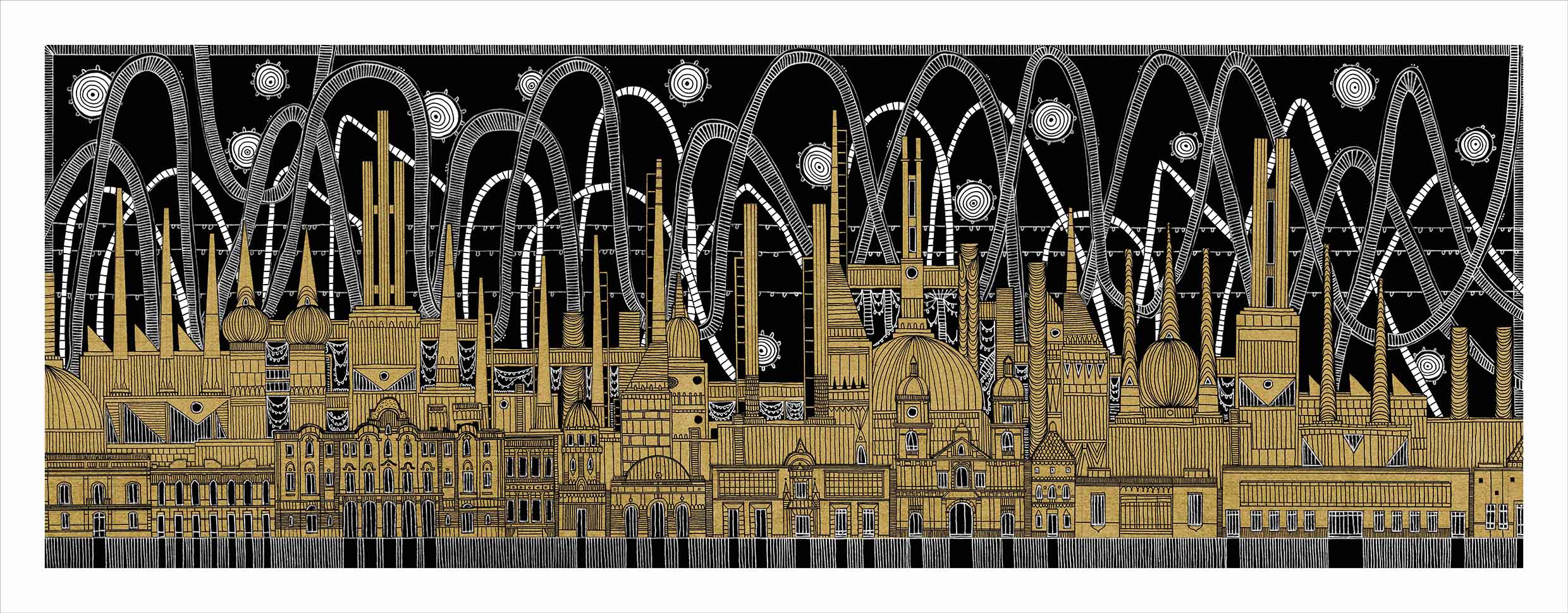
For the project “The Compound Narrative” was resquest to choose between the books “Invisible Cites” of Italo Calvin and “Jesus’ Son” of Dennis Jonhson . The objective was creating an editorial design project with a new interpretation of the book selected containing new information. The added information could be in any form (text or images).
“Invisible Cities” Italo Calvin (1972)
Invisible Cities, a book by Italo Calvino, first published 1972, is a collection of fiffty-five citys, explores imagination and the imaginable through the descriptions of cities by an explorer, Marco Polo, the famous Venetian Trabaler and Kublai Kan, the legendary conqueror.
This project is a personal interpretation of the book, witch aims to present its content though a visual representation, each one of the cities was illustrated with a geometric base in order to provide the reader a different interpretation.
The cities are divided in eleven categories: “Cities & Memory”, “Cities & Desire”, “Cities & Signs”, “Thin Cities”, “Trading Cities”, “Cities & Eyes”, “Cities & Names”, “Cities & the Dead”, “Cities & the Shy”, “Continuous Cities” and “Hidden Cities”. Each one were also illustrated and defined with a unique color palette constituted with three different colors, and black/white was common colors among all of them. In the end a pattern can be seen as a representation of the space of each category.




Visual Research
This is an example post, originally published as part of Blogging University. Enroll in one of our ten programs, and start your blog right.
You’re going to publish a post today. Don’t worry about how your blog looks. Don’t worry if you haven’t given it a name yet, or you’re feeling overwhelmed. Just click the “New Post” button, and tell us why you’re here.
Why do this?
The post can be short or long, a personal intro to your life or a bloggy mission statement, a manifesto for the future or a simple outline of your the types of things you hope to publish.
To help you get started, here are a few questions:
You’re not locked into any of this; one of the wonderful things about blogs is how they constantly evolve as we learn, grow, and interact with one another — but it’s good to know where and why you started, and articulating your goals may just give you a few other post ideas.
Can’t think how to get started? Just write the first thing that pops into your head. Anne Lamott, author of a book on writing we love, says that you need to give yourself permission to write a “crappy first draft”. Anne makes a great point — just start writing, and worry about editing it later.
When you’re ready to publish, give your post three to five tags that describe your blog’s focus — writing, photography, fiction, parenting, food, cars, movies, sports, whatever. These tags will help others who care about your topics find you in the Reader. Make sure one of the tags is “zerotohero,” so other new bloggers can find you, too.
 Isabel Dias